Captain Ratatype

Typing speed levels: from novice to expert
We grouped all participants into seven categories based on their typing speed in words per minute (WPM).
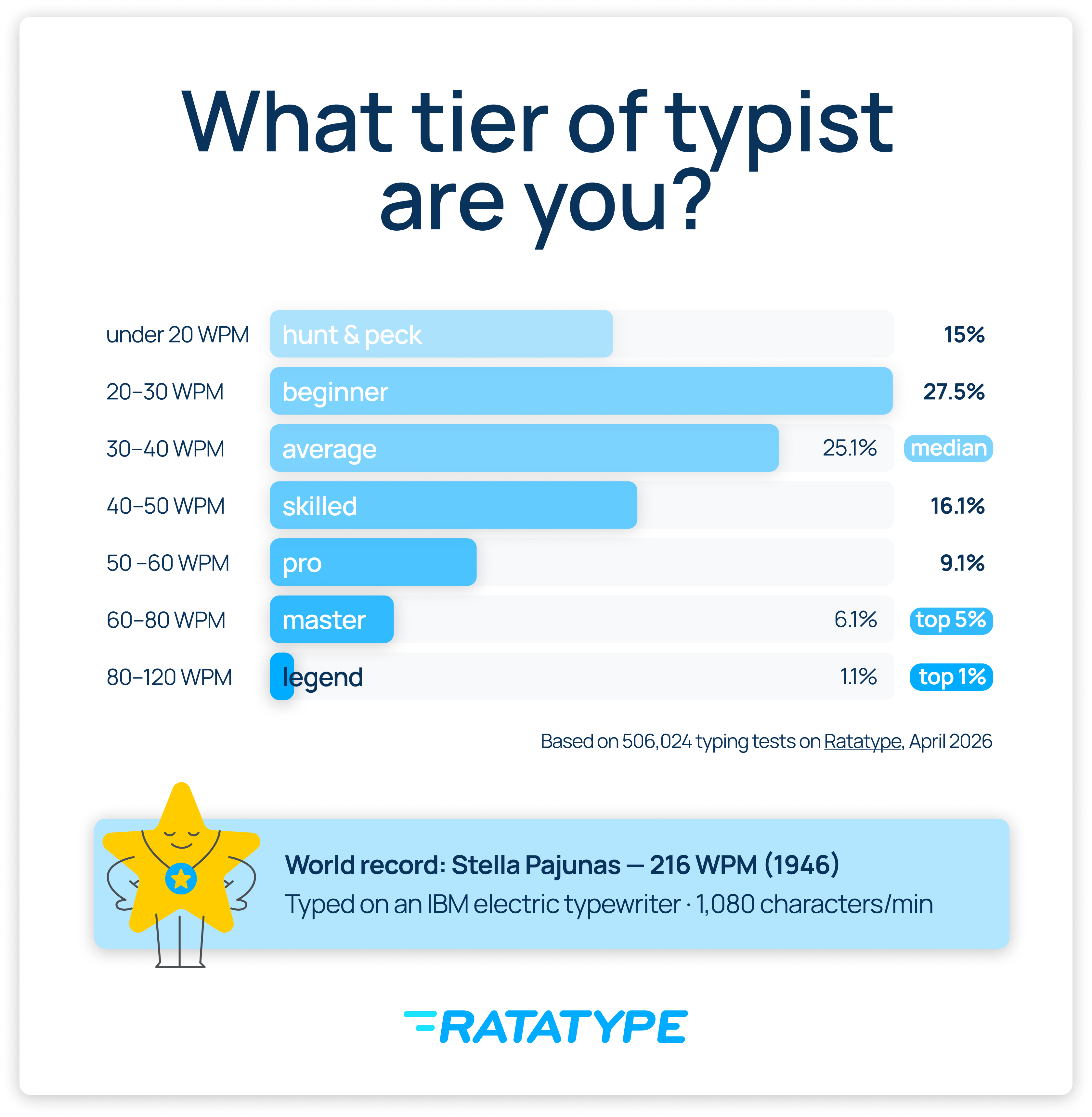
Hunt & Peck: below 20 WPM (15% of users)
This style involves typing with two fingers while visually searching for each key. Around one in seven users types this way. It’s slow, but still works for everyday needs.
Beginner: 20–30 WPM (27.5%)
The most common level. Nearly a third of users fall into this group. They’re familiar with the keyboard, but haven’t yet developed a consistent rhythm. For large volumes of text, this is still limiting.
Average: 30–40 WPM (25.1%) — median
This is the midpoint. Half of users type slower, half faster. It’s enough for typical office tasks, though there’s still room to improve efficiency.
Skilled: 40–50 WPM (16.1%)
At this stage, typing becomes more comfortable. Attention shifts from keys to content. A solid level for most computer-based roles.
Pro: 50–60 WPM (9.1%)
Roughly one in eleven users reaches this level. Typing is noticeably faster, with less strain and higher daily output.
Master: 60–80 WPM (6.1%) — top 5%
Reaching this level places you among the fastest typists globally. Common among experienced developers, journalists, and translators who rely on the keyboard daily.
Expert: 80–120 WPM (1.1%) — top 1%
This is the top tier. Typing becomes almost automatic, with minimal conscious effort. Very few reach this level.
What is the typical typing speed?
Based on our data, the median sits within the 30–40 WPM range, meaning an average of around 35 words per minute.
For context: people speak at roughly 130 words per minute. This means we think significantly faster than we type — leaving clear potential for improving productivity.
If you increase your speed from 35 to 60 WPM and spend around 4 hours a day typing, you could save close to 1.5 hours daily. That’s over 30 working days per year.
World record: 216 WPM in 1946
The fastest recorded typist is Stella Pajunas. In 1946, she reached 216 WPM on an IBM electric typewriter — about 1,080 characters per minute, or 18 characters per second.
For comparison: if an average user types one word in around 1.7 seconds, Stella managed it in under 0.3 seconds.
This record has stood for nearly 80 years and remains unbeaten in traditional typewriting.
How can you improve your typing speed?
The good news: typing is a trainable skill. It doesn’t require innate talent — just consistent practice.
A few proven principles:
- Learn touch typing. If you still look at the keyboard, start here. It frees up attention and improves speed.
- Practise regularly, but briefly. 15 minutes daily is more effective than long, irregular sessions.
- Focus on accuracy first. Speed improves naturally once mistakes are reduced.
- Track your progress. Regular testing helps maintain motivation and measure improvement.
Take a free test on Ratatype — find your level and start improving today!